ブルームズベリー版 応用言語学の最前線(全5巻):研究課題と方法
Bloomsbury Applied Linguistics : Research Issues and Methods
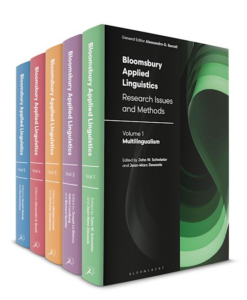
Editor: Alessandro G. Benati, Professor in the School of Education, University College Dublin
2025:12 5 vols. 1,600 p. set ISBN 978-1-350-21358-6 (Bloomsbury Academic) -GB-
★在庫特価15%OFF *2026年7月15日まで適用(GBP 561 )
Web販売価格 150,436 (税込) / 標準価格 183,895 (税込)
通常価格 (GBP 660) Web販売価格 173,514 (税込) / 標準価格 216,348 (税込)
*2026年6月1日時点の価格です。実際の価格は、為替レートや出版社の都合により変動いたしますので、最新の価格は以下オンラインストアリンクをご参照ください。
*Web販売価格は、紀伊國屋書店BookWeb Proでご注文され、付帯作業を伴わない納品を行い、弊社標準書式による請求書を発行し遅滞なくお支払いただく場合、あるいは、クレジットカードでお支払いいただく場合に適用される販売価格です。
セット内容
第1巻:多言語使用 Volume I: Multilingualism
第2巻:言語政策・計画 Volume II: Language Policy and Planning
第3巻:第二言語習得 Volume III: Second Language Acquisition
第4巻:語学教育 Volume IV: Language Teaching and Pedagogy
第5巻:語学力評価 Volume V: Language Assessment
概要
「応用言語学」は、言語教育から社会言語学までの幅広いテーマを含む、言語のあらゆる実践の場にかかわる知見を結集する一大分野です。人気テーマが集中し、競争が非常に激しい分野でもあります。
各巻にて応用言語学の主要テーマを取り上げる全5巻セットの本書は、過去の論文の集成ではなく、いずれも第一線の研究者が本書のために書き下ろした全76章を収録し、最前線の風景へと案内する、全応用言語学研究者必携コレクションです。それぞれの研究テーマで今日最も関心を集めている課題と最も重要な方法論の進展を体系的に概観できる構成で、効率よく応用言語学の現在地を確認できます。国内外の著名な研究者が多数寄稿している中で、木村護郎クリストフ(上智大学)、西澤倫(麗澤大学)、ジョン・M・ノリス(ETS Japan)、バトラー後藤裕子(米ペンシルバニア大学)、フロリアン・クルマス(独デュースブルク=エッセン大学)の名を見ることができます。
21世紀の応用言語学の最新最大の見取図として、本書をおすすめいたします。
価格照会・ご購入
※本件についてのお問い合わせ、お見積りについては、最寄りの紀伊國屋書店営業所もしくはこちらのお問い合わせフォームまでご連絡ください。
収録内容明細(全5巻)
Volume 1: Multilingualism
Edited by John W. Schwieter (Wilfrid Laurier University, Canada) and Jean-Marc Dewaele (Birkbeck, University of London, UK)
Introduction: John W. Schwieter (Wilfrid Laurier University, Canada) and Jean-Marc Dewaele (Birkbeck University of London, UK)
Part I: The Development of More Than One Language
- Simultaneous and Sequential Acquisition of Multiple Languages: Annick De Houwer (University of Erfurt, Germany) and Lourdes Ortega (Georgetown University, USA)
- Multimodality Meets Multilingualism: Modality-Specific Effects when Switching Languages: Andrea M. Philipp (RWTH Aachen University, Germany) and Iring Koch (RWTH Aachen University, Germany)
Part II: Multilingualism, Mind, and Brain
- Multilingualism and the Mind: Katarzyna Jankowiak (Adam Mickiewicz University, Poland), Roberto R. Heredia, and John W. Schwieter (Wilfrid Laurier University, Canada)
- Multilingualism and the Brain: Juliana Ronderos (Boston University, USA), Jean P. Bodet III (Baylor University, USA), My V. H. Nguyen (University of Houston, USA), and Arturo E. Hernandez (University of Houston, USA)
- Effects of Bi-/Multilingualism on Cognition: Gregory J. Poarch (University of Groningen, the Netherlands) and Julia Festman (University College of Teacher Education Tyrol, Austria)
Part III: Multilingualism and the Self
- Multilingualism and Identity: Claire Kramsch (University of California, Berkeley, USA) and David Gramling (University of British Columbia, Canada)
- Multilingualism and Emotional Resonance: Jean-Marc Dewaele (Birkbeck University of London, UK), Pernelle Lorette (University of Mannheim, Germany), Louise Rolland (Birkbeck, University of London, UK), and Irini Mavrou (Universidad Antonio de Nebrija, Spain)
Part IV: Multilingualism Throughout Life
- Multilingualism in Four Developmental Stages: Considering endogenous and Exogenous Factors as Sources of Variation: Gigi Luk (McGill University, Canada), John A. E. Anderson (Carlton University, Canada), and Justin Feng (McGill University, Canada)
- Language Attrition and Maintenance in Multilinguals: Barbara Köpke (University of Toulouse, France)
Part V: Multilingualism in Education and Society
- Disentangling ‘Bi/multilingualism’ in Education and Language Policy: Southern Decolonial Multilingualism: Ruanni Tupas (University College London, UK) and Ofelia García (The Graduate Center, CUNY, USA)
- Multilingualism in Societies and Communities: Patricia A. Duff (University of British Columbia, Canada)
- Multilingualism and Monolingual Institutional Ideologies: Elisabeth Barakos (University of Hamburg, Germany) and Charlotte Selleck (University of the West of England, UK)
Part VI: Multilingualism in a Connected World
- Language, Culture, and Globalization: Mark Cleveland (Western University, Canada) and Nicolas Papadopoulos (Carleton University, Canada)
- Multilingualism, Media, and Digital Technology: Helen Kelly-Holmes (University of Limerick, Ireland)
Conclusion: Jean-Marc Dewaele (Birkbeck University of London, UK) and John W. Schwieter (Wilfrid Laurier University, Canada)
Index
Volume 2: Language Policy and Management
Edited by Joseph Lo Bianco (University of Melbourne, Australia) and Bernard Spolsky (Bar-Ilan University, Israel)
Introduction: Joseph Lo Bianco (University of Melbourne, Australia) and Adrian Lundberg (Malmö University, Sweden)
Part I: Theories and Frameworks
- Normative Language Policy: A New Interdisciplinary Framework for LPP Research: Leigh Oakes (Queen Mary University of London, UK)
- Language Policy in Multilingual Societies: Practical Ethics and Ethical Practice: Yael Peled (Inland Norway University of Applied Sciences, Norway)
- Language Policy, Laws, and Regulations: A Transdisciplinary Approach: Subhan Zein (Universitas Pendidikan Indonesia, Indonesia)
- Language Politics and Linguistic Citizenship: Tommaso M. Milani (Pennsylvania State University, USA)
- Transnational Structures and Forces of Language Policy Management: Lisa McEntee-Atalianis (Birkbeck, University of London, UK)
- Language Policy: The Home and the Neighbourhood: Elizabeth Lanza (University of Oslo, Norway) and Christine Anthonissen (Stellenbosch University, South Africa)
- The Contribution of Constructed Languages in Language Policy and Management: Federico Gobbo (University of Amsterdam, the Netherlands)
Part II: Perspectives and Issues
- The Study of Religious Language Policy and Management: Andrey Rosowsky (University of Sheffield, UK)
- Gender- and Sexuality-Related Language Policies: Heiko Motschenbacher (Western Norway University of Applied Sciences, Norway)
- Globalization and International Languages: Florian Coulmas (University of Duisburg-Essen, Germany)
- The Workforce and the Economy: Kellie Gonçalves (University of Bern, Switzerland)
- Language Policy and Management for Sign Languages: Kristin Snoddon (Toronto Metropolitan University, Canada) and Maartje De Meulder (University of Applied Sciences Utrecht, the Netherlands)
- Language Endangerment, Shift, and Revitalization: Gerald Roche (La Trobe University, Australia) and Anna Belew (University of Hawai?i at Manoa, USA)
14. Public Media and Social Media: Helen Kelly-Holmes (University of Limerick, Ireland)
Part III: Methods and Cases
- Approaches to Agency: Goro Christoph Kimura (Sophia University, Tokyo)
- Municipal Language Policy: Libraries in Sydney and the Implications of the 2021 Census: Alice Chik (Macquarie University, Australia) and Chloe Castle (University of Adelaide, Australia)
- Decolonial Studies in Mother Tongue-Based Multilingual Education: Ruanni Tupas (University College London, UK) and Grace M. Saqueton (University of the Philippines-Diliman, the Philippines)
- Linguistic Diversity and School Language Policies: Ingrid Gogolin (University of Hamburg, Germany)
- Individual Agency in Family’s Language Management: Founding Principles, Methodologies and Future Potentials: Anik Nandi (Woxsen University, India)
- Indigenous Peoples’ Translanguaging in Australia: Linguistic and Cultural Heritage, Contemporary Language Policy and Management: Rhonda Oliver (Curtin University, Australia), Debra Hannagan (Independent Researcher, Australia), Mystique Dia (Independent Researcher, Australia) and Sender Dovchin (Curtin University, Australia)
Conclusion: Some Final Reflections on Future Directions: Joseph Lo Bianco (University of Melbourne, Australia) and Adrian Lundberg (Malmö University, Sweden)
Index
Volume 3: Second Language Acquisition
Edited by Michael Leeser (Florida State University, USA) and Gretchen Sunderman (Florida State University, USA)
- Introduction: Origins and Foundations of Second Language Acquisition: Michael J. Leeser and Gretchen Sunderman (Florida State University, USA)
Part I: The ‘What’ of L2 Acquisition
- Phonology: John Archibald (University of Victoria, Canada)
- Morphology: Roumyana Slabakova (University of Southampton, UK)
- Lexicon: Emi Iwaizumi and Stuart Webb (University of Western Ontario, Canada)
- Syntax: Silvina Montrul (University of Illinois at Urbana-Champaign, USA) and Lydia White (McGill University, Canada)
- Pragmatics: Yunwen Su (University of Illinois at Urbana-Champaign, USA)
Part II: Factors that (Do Not) Affect L2 Acquisition
- Formal Instruction: Bill VanPatten
- Second Language Learning in Study Abroad Contexts: John Schwieter (Wilfrid Laurier University, Canada), Martin Howard (University College Cork, Ireland) and Jane Jackson (The Chinese University of Hong Kong, Hong Kong)
- Age of Learning and Second Language Attainment: David Birdsong (University of Texas at Austin, USA)
10. Cognitive Factors in L2 Acquisition: Gisela Granena (Universitat Oberta de Catalunya, Spain) and Yucel Yilmaz (Indiana University, USA)
- Social and Affective Factors in L2 Learning: Matthew Kanwit (University of Pittsburgh, USA), Aarnes Gudmestad (Virginia Tech University, USA) and Megan Solon (Indiana University, USA)
Conclusion: Common Themes and Future Directions: Michael J. Leeser and Gretchen Sunderman (Florida State University USA)
Index
Volume 4: Language Teaching and Pedagogy
Edited by Alessandro Benati (University of Hong Kong, Hong Kong)
Introduction: How Language Pedagogy Might Influence Language Development: Alessandro Benati (University College Dublin, Ireland)
- New Frontiers for Language Instruction: Theory, Research and Pedagogy: Alessandro Benati (University College Dublin, Ireland)
- Effective and Efficient L2 Processing: Insights from Select Eye-Tracking Research in Instructed Second Language Acquisition: James Lee (University of Texas Tech, USA)
- The Use of Electroencephalography in Second Language Instructional Contexts: Assets and Challenges for the Classroom: Tanya Angelovska (Salzburg University, Austria) and Ditmar Roehm (Salzburg University, Austria)
- Input Enhancement: Issues in Grammar and Vocabulary Learning: Wynne Wong (Ohio State University, USA)
- Humor and Metaphor in Instructed Second Language Acquisition: The Role of Technology in Advanced Development: Shana Scucchi (University of South Carolina, USA) and Paul Malovrh (University of South Carolina, USA)
- Implicit Knowledge Acquisition: Pedagogic Interventions and Assessment Tools: Ilaria Borro (University of Bergamo, Italy)
- Quantity and Quality of Second Language Vocabulary Learning: From Theory and Research to Evidence-Based Instruction: Joe Barcroft (Washington University in S. Louis, USA)
- The Role of Tasks in Second Language Acquisition and Language Teaching: Paul Mandell (University of Houston-Downtown, USA), Justin White (Florida Atlantic University, USA) and Anel Brand (Florida State University, USA)
- Written Corrective Feedback: Exploration into a Consensual Typology and Theoretical Foundations: Víctor Parra-Guinaldo (Prince Mohammad Bin Fahd University, Saudi Arabia)
- Collaborative Language Learning: Basis and Implementations: Ali Shehadeh (UAEU, UAE)
- The Teacher Behind the Curtain: Investigating L2 Learning in (e)Tandem Settings: Elena Nuzzo (Universita Roma 3, Italy)
- Approximating Immersion Learning in Classroom Settings: How It’s Done and What It Means for Learners: Gabrielle Klassen (Wilfrid Laurier University, Canada) and John W. Schwieter (Wilfrid Laurier University, Canada)
13. Individual Differences in Bilingual Classrooms: Implications for Teaching and Research in Bilingualism: Pedro Guijarro Fuentes (Universidad de las Islas Baleares, Spain)
- Cross-Modal Speech Learning and Its Pedagogical Implication in SLA: Xin Wang (Macquarie University, Australia), Mei Si (Rensselaer Polytechnic Institute, USA), Weifeng Han (Federation University, Australia) and Liang Chen (University of Georgia, USA)
- Evaluative Resources of a High-Stakes Academic Event in MICASE: Implications for Advanced Academic Literacy Teaching and Pedagogy: Ken Lau (University of Hong Kong, SAR) and Chia-Yen Lin (Yuan Ze University, Taiwan)
- Online Effects of Structured Input: Insights from a Self-Paced Reading Study: Najat Alabdullah (The University of Hong Kong) and Alessandro Benati (University College Dublin, Ireland)
Index
Volume 5: Language Assessment
Edited by Hossein Nassaji (University of Victoria, Canada) and Eva Kartchava (Carleton University, Canada)
Introduction: Hossein Nassaji (University of Victoria, B.C., Canada) and Eva Kartchava (Carleton University, Canada)
Part I: General Issues in Assessment
- Approaches to Language Assessment: Zhi Li (University of Saskatchewan, Canada)
- Test Use Consequences: Shahrzad Saif (Université Laval, Canada)
- Technology-Based Language Assessment: Carol A. Chappelle (Iowa State University, USA) and Haeun Kim (Iowa State University, USA)
- Task-Based and Performance-Based Language Assessment: John M. Norris (ETS Japan, Japan)
- Dynamic Assessment: Ali Kushki (Purdue University, USA)
Part II: Skill-Based Assessment
- Assessing Reading Comprehension: John Read (University of Auckland, New Zealand) and Xiaohua Liu (Chinese University of Hong Kong, Hong Kong)
- ESP Assessment: Reading Skills in Business English Programs: Shahid Abrar-ul-Hassan (Yorkville University, Canada) and Dan Douglas (Iowa State University, USA)
- Assessing Listening: Olena Rossi (Independent Researcher, Italy) and Philip Horne (Lancaster University, UK)
- Skills-based Assessment: Speaking: Dustin Crowther (University of Hawai’i, Hawai’i), Hitoshi Nishizawa (Reitaku University, Japan) and In Ji Sera Chun (University of Hawai’i, Hawai’i)
- Vocabulary Assessment: Samuel Barclay (Nottingham Trent University, UK) and Ana Pellicer-Sánchez (University College London, UK)
- Pragmatics Assessment: Zohreh R. Eslami (Texas A&M University, USA), Azizullah Mirzaei (Shahrekord University, Iran) and Hector H. Rivera (Texas A&M University, USA)
Part III: Learner-Agentive Assessment
- Self-Assessment: Yuko Goto Butler (University of Pennsylvania, USA)
- Peer Assessment: Betty McDonald (University of Trinidad and Tobago, Trinidad and Tobago)
- Portfolios: Christine Doe (Mount Saint Vincent University, Canada)
- Developing Literacy and Competence in Language Assessment: Beverly Baker (University of Ottawa, Canada) and Louis-David Bibeau (University of Montreal, Canada)
Index
(紀伊國屋書店 学術洋書部)