新ケンブリッジ版 英語史(全6巻)
The New Cambridge History of the English Language
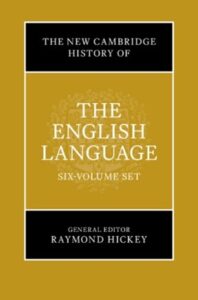
Genral Editor: Raymond Hickey, University of Limerick
2026:05 6 vols. 5,552 p. ISBN 978-1-009-20202-2 (Cambridge University Press) -GB-
GBP 950
Web販売価格 ¥244,530 (税込) / 標準価格 ¥306,185 (税込)
※上記セット価格は、下記の各巻分売価格合計の約5% offの特価となっております。
- 第1巻:文脈、言語接触、発達
Volume 1 : Context, Contact and Development
2025:10 896 p. ISBN 9781009205689 GBP 140
Web販売価格 ¥36,036 (税込) / 標準価格 ¥45,122 (税込)
- 第2巻:ドキュメンテーション、データソース、モデリング
Volume 2 : Documentation, Sources of Data and Modelling
2025:10 906 p. ISBN 9781009205450 GBP 140
Web販売価格 ¥36,036 (税込) / 標準価格 ¥45,122 (税込)
- 第3巻:継承、変化、イデオロギー
Volume 3 : Transmission, Change and Ideology
2025:10 840 p. ISBN 9781009205863 GBP 140
Web販売価格 ¥36,036 (税込) / 標準価格 ¥45,122 (税込)
- 第4巻:英国、アイルランド、ヨーロッパ
Volume 4 : Britain, Ireland and Europe
2026:03 776 p. ISBN 9781009205825 GBP 140
Web販売価格 ¥36,036 (税込) / 標準価格 ¥45,122 (税込)
- 第5巻:北米、カリブ海
Volume 5 : North America and the Caribbean
2026:04 896 p. ISBN 9781009205764 GBP 140
Web販売価格 ¥36,036 (税込) / 標準価格 ¥45,122 (税込)
- 第6巻・第1部:アフリカ
Volume 6, Part 1 : Africa, Asia, Australasia and the Pacific
2026:05 672 p. ISBN 9781009206204 GBP 140
Web販売価格 ¥36,036 (税込) / 標準価格 ¥45,122 (税込)
- 第6巻・第2部:アジア太平洋
Volume 6, Part 2 : Africa, Asia, Australasia and the Pacific
2026:05 584 p. ISBN 9781009748179 GBP 140
Web販売価格 ¥36,036 (税込) / 標準価格 ¥45,122 (税込)
*2026年4月23日時点の価格です。実際の価格は、為替レートや出版社の都合により変動いたしますので、最新の価格は以下オンラインストアリンクをご参照ください。
*Web販売価格は、紀伊國屋書店BookWeb Proでご注文され、付帯作業を伴わない納品を行い、弊社標準書式による請求書を発行し遅滞なくお支払いただく場合、あるいは、クレジットカードでお支払いいただく場合に適用される販売価格です。
*本書は電子書籍版もCambridge Coreにて提供されます。詳細はお問い合わせください。
各巻Online ISBN:(Vol.1) 9781009205702 / (Vol.2) 9781009205443 / (Vol.3) 9781009205870 /(Vol.4) 9781009205818 / (Vol.5) 9781009205771 / (Vol.6.1) 9781009206235 / (Vol.6.2) 9781009748148
概要
ケンブリッジ大学出版の20世紀の著名シリーズ「ケンブリッジ版 英語史」全6巻(1992-2001年)The Cambridge History of the English Language(日本国内では250を超える大学図書館に所蔵)に続く、待望の「新ケンブリッジ版 英語史」全6巻のセットです。
本書は、英語史のあらゆる側面を対象とし、過去25年間に得られた最新の英語史研究の成果を概観します。この分野を代表する第一線の研究者を結集した本書は、全6巻・171章にわたって、近年の研究動向や理論的アプローチに焦点を当てるとともに、英語史の様々な下位分野に関する最先端の知見を示します。本書の寄稿者には、総編集者であるRaymond Hickeyをはじめ、David Crystal、Terttu Nevalainen、Lesley Milroy、Walt Wolfram、山口登志子、三浦あゆみ、松本和子らが名を連ねます。まず第1巻では、1千年紀における英語の形成過程に焦点を当て英語史を理解するための歴史的枠組み(印欧語族・ゲルマン語派としての背景、音韻論・形態論の諸要素がいかに古英語期まで存続したのか、初期英語話者と他言語話者の間の言語接触など)を検討します。第2巻では、英語史を記録する多様なテクストを対象に、通時的データ、文献資料を取り上げ、言語分析のための理論モデルを示します。第3巻では、英語史における言語変化がいかに顕在化してきたかに焦点を当て、辞書や文法書を通じた英語の伝達から、デジタル手段による伝播まで、英語がいかに継承・共有されてきたかを検討します。第4巻以降では、各地域の英語史に焦点を当て、まず第4巻では、イギリス、アイルランド、ヨーロッパにおける地域変種としての英語の歴史(初期ロンドン英語、スコッツ語、標準スコットランド英語など)を取り上げ、第5巻では、北米、カリブ海地域における英語の歴史(初期入植者集団の英語から、現代のアメリカ合衆国、カナダ、カリブ地域の英語まで)を詳述します。第6巻は、二部構成となっており、第1部ではアフリカにおける英語変種を取り上げ、西・東・南アフリカは歴史的背景、人口動態の違いにより、それぞれ異なる言語生態を有していることを示しています。第2部ではアジア、オーストラリア、太平洋地域における英語の変種を取り上げ、アジアの中でも南・東南アジアでは英語変種の性質に共通点が見られ、東アジアの英語変種の重要性が近年増していることを指摘しています。
英語学・英語教育に携わる方々にとって必携のレファレンスとして本書をおすすめいたします。
価格照会・ご購入
※本件についてのお問い合わせ、お見積りについては、最寄りの紀伊國屋書店営業所もしくはこちらのお問い合わせフォームまでご連絡ください。
収録内容明細
Volume 1 : Context, Contact and Development
Volume I: General Editor’s introduction (Raymond Hickey)
Introduction to volume I (Laura Wright and Raymond Hickey)
Part I. The Context of English:
- The Indo–European framework (Donald Ringe)
- English in its Germanic surrounding (Wayne Harbert)
- Language development in the old English period (Julia Fernández Cuesta)
- The geography of English in England (Merja Steenroos)
- Philology and the history of English (Laura Wright and Raymond Hickey)
Part II. Contact and External Influences:
- Early contact with Celtic (Raymond Hickey)
- Latin in the early history of English (Olga Timofeeva)
- Scandinavian Influence (Richard Dance and Sarah Pons–Sanz)
- Anglo-Norman, its dictionary and the study of English vocabulary (Geert de Wilde)
- Code–Switching and language mixing (Herbert Schendl)
- Early standardisation (Louise Sylvester)
- Neoclassical borrowings and their influence on English (Letitia Vezzosi and Luca Baratta)
- Typological reorientation in the history of English (Marion Elenbaas)
Part III. The Long View by Levels and Areas of Language:
- Historical phonology (Donka Minkova)
- Historical morphology (Elżbieta Adamczyk)
- Historical syntax (Bettelou Los)
- Historical semantics (Kathryn Allan)
- Historical pragmatics (Andreas Jucker)
- Historical sociolinguistics (Terttu Nevalainen and Tanja Säily)
- Historical onomastics (Richard Coates)
Appendix: Recommended reading
Volume 2 : Documentation, Sources of Data and Modelling
General Editor’s Introduction: English, Englishes and the history of the English language (Raymond Hickey)
Introduction to Volume II (Merja Kytö, Erik Smitterberg and Raymond Hickey)
Part I. The Textual Record:
- Early English inscriptions, glosses and documents (Jeremy J. Smith)
- Vernacular speech in writing (Colette Moore)
- Orality in the history of English (Matylda Włodarczyk)
- The story of English orthography, and its analysis (Ondřej Tichý and Jan Čermák)
- English manuscript traditions (Christine Wallis)
- Text editions and the philological tradition (Matti Peikola)
- The history of books and printing (Sarah L. Noonan)
- Historical corpora of English (Merja Kytö and Erik Smitterberg)
- Historical thesauri of English (Marc Alexander and Fraser Dallachy)
- Assessing loanwords and other borrowed elements in the English lexicon (Philip Durkin)
- Historical slang (Jonathon Green)
- Phraseology: from phrasal verbs to proverbs (Gabriele Knappe)
- The language of dialect writing (Javier Ruano-García)
Part II. Lighthouse Works and Authors:
- Beowulf as a source text for archaic features (R. D. Fulk)
- Language use in Chaucer’s canterbury tales (Simon Horobin)
- Shakespeare’s language (Jonathan Culpeper and Sean Murphy)
Part III. Genre and Medium in the Record:
- Grammatical treatises in early English (Annina Seiler and Nicole Studer-Joho)
- History writing (Claudia Claridge)
- The language of religious texts (Tanja Kohnen and Thomas Kohnen)
- The language of courtroom documents (Terry Walker)
- Medical and scientific writing (Irma Taavitsainen and Turo Hiltunen)
- The language of newspapers (Birte Bös and Nicholas Brownlees)
- ‘Bad data’: the case for early audio records (Raymond Hickey)
- Ego documents in the history of English (Anita Auer and Raymond Hickey)
- Personal letters in a community context (Samuli Kaislaniemi and Anni Sairio)
- Women’s voices in the history of English (Carol Percy)
Part IV. Modelling the Record: Methods and Theories:
- Quantitative methods and the history of English (Axel Bohmann and Lotte Sommerer)
- Generative accounts of change (Cynthia L. Allen)
- Functional accounts of change (Hubert Cuyckens)
- Grammaticalisation (Andrew D. M. Smith)
- Cognitive approaches to the history of English (Alexander Bergs)
- Construction grammar and English historical linguistics (Martin Hilpert)
- Psycholinguistic perspectives on language change (Marianne Hundt, Simone E. Pfenninger and Sandra Mollin)
Appendix: list of corpora and other electronic resources.
Volume 3 : Transmission, Change and Ideology
General editor’s introduction (Raymond Hickey)
Introduction (Joan C. Beal and Raymond Hickey)
Part I. The Transmission of English:
- Dictionaries in the history of English (John Considine)
- Writing grammars for English (Ingrid Tieken–Boon van Ostade)
- Speech representation in the history of English (Peter Grund)
- Digital interaction in the history of English (Caroline Tagg and Melanie Evans)
- Internet resources for the history of English (Ayumi Miura三浦 あゆみ・東京大学)
Part II. Tracking Change in the History of English:
- Spelling practices and emergent standard writing (Juan Camilo Conde Silvestre and Juan Manuel Hernández Campoy)
- Phonological change (Gjertrud Flermoen Stenbrenden)
- Applying historical phonology (David Crystal)
- The emerging phonological standard (Lynda Mugglestone)
- The history of R in English (Raymond Hickey)
- The system of clausal complementation (Hendrik de Smet)
- Tense and aspect in the history of English (Teresa Fanego)
- Development in the passive construction (Peter Petré)
- Adverbs in the history of English (Ursula Lenker)
- The story of English negation (Gabriella Mazzon)
- Dative and genitive variability in the history of English (Anette Rosenbach)
- Relativisation (Cristina Suárez Gómez)
- Recent grammatical change in English (Jill Bowie and Bas Aarts)
- The history of English registers (Nuria Yáñez Bouza and Javier Perez Guerra)
- The history of semantic theory (Susan Fitzmaurice and Seth Mehl)
- The development of pragmatic markers (Laurel Brinton)
Part III. Ideology, Society and the History of English:
- The ideology of standard English (Lesley Milroy)
- The discourse of prescriptivism (Don Chapman)
- English dictionaries from the Eighteenth–century onwards (Charlotte Brewer)
- Networks, coalitions and language change (Marina Dossena)
- Communities of practice in the history of English (Joanna Kopaczyk and Andreas Jucker)
- Historical enregisterment (Joan Beal and Paul Cooper)
Volume 4 : Britain, Ireland and Europe
General editor’s introduction (Raymond Hickey)
Introduction to Volume IV (Raymond Hickey)
Part I. Language Variation and Change:
- Sociolinguistic sources of change (Devyani Sharma
- Lifespan changes and the history of English (Isabelle Buchstaller and Susanne Evans–Wagner)
- Supraregional varieties, standards and vernaculars (Raymond Hickey)
- Historical divisions and perceptual dialectology (Chris Montgomery)
Part II. English in England:
- Dialects dialectology and history of English (Warren Maguire)
- The history of received pronunciation (Anne Fabricius)
- Early London English (Laura Wright)
- The recent history of London English (Susan Fox)
- English in South–West of England (Susanne Wagner)
- English in East Anglia (David Britain and Robert Potter)
- English in midlands (Esther Asprey and Natalie Braber)
- English in Merseyside (Anthony Grant and Raymond Hickey)
- English in Tyneside (Adam Mearns)
Part III. English in Wales:
- History of English in Wales (Robert Penhallurick)
Part IV. English in Scotland:
- The history of Scots (Joanna Kopaczyk)
- The lexicography of Scots (Maggie Scott)
- Scots and Scottish standard English (Jane Stuart–Smith and Rachel Macdonald)
- English in Orkney and Shetland (Peter Sundkvist)
Part V. English in Ireland:
- History and diffusion of Irish English (Raymond Hickey)
- Southern Irish English (Raymond Hickey)
- Northern Irish English (Raymond Hickey)
Part VI. English in Europe:
- English in Channel Islands (Heinrich Ramisch)
- English in Gibraltar (Christina Suárez–Gómez and Elena Seoane)
- English in Malta (Alexandra Vella and Sarah Grech)
- English in Cyprus (Sarah Buschfeld and Manuela Vida–Mannl)
Volume 5 : North America and the Caribbean
General Editor’s introduction (Raymond Hickey)
Introduction to Volume V (Natalie Schilling, Derek Denis and Raymond Hickey)
Part I. The United States:
- Language change and the history of American English (Walt Wolfram)
- The dialectology of Anglo–American English (Natalie Schilling)
- The roots and development of New England English (James Stanford)
- The history of the Midland–Northern boundary (Matthew J. Gordon)
- The spread of English westwards (Valerie Fridland and Tyler Kendall)
- American English in the city: the case of Pittsburgh (Barbara Johnstone)
- New York City and Baltimore (Aidan Malanoski and Michael Newman)
- English in the southern United States (Becky Childs and Paul Reed)
- Contact forms of American English (Cristopher Font–Santiago and Joseph Salmons)
- The roots of African American English (Tracey Weldon)
- The great migration and regional variation in the speech of African Americans (Charlie Farrington)
- Rural African American English (Patricia Cukor–Avila)
- Urban African American English (Nicole Holliday)
- Puerto Rican English (Rosa Guzzardo Tamargo)
- The English of Americans of Mexican and central American heritage (Erik Thomas)
Part II. Canada:
- Anglophone settlement and the creation of Canadian English (Charles Boberg)
- The Open-Class lexis of Canadian English: history, structure, correlations (Stefan Dollinger)
- Ontario English: loyalists and beyond (Derek Denis, Bridget Jankowski and Sali Tagliamonte)
- The prairies and the west of Canada (Alexandra D’Arcy and Nicole Rosen)
- Canadian maritime English: solidarity and resistance, yeah (Matt Hunt Gardner)
- English in Newfoundland (William Kirwin, Sandra Clarke and Raymond Hickey)
- English as a minority language in Quebec: a (socio)linguistic aperçu (Shana Poplack)
Part III. The Caribbean:
- Early English–lexifier creole in the circum-Caribbean area (Norval Smith)
- The Caribbean anglophone contact varieties: creoles and koinés (Jeffrey Williams)
- English in Jamaica – between local and foreign (Sylvia Kouwenberg)
- The anglophone Caribbean rim (Angela Bartens)
- North American–Caribbean linguistic connections (Stephanie Hackert)
Volume 6, Part 1 : Africa, Asia, Australasia and the Pacific
General editor’s introduction (Raymond Hickey)
Introduction to Volume VI (Raymond Hickey)
Part I. The Spread of English Overseas:
- Transported English in the colonial period (Raymond Hickey)
- Modelling the formation and developmental trajectories of varieties of English (Edgar W. Schneider)
- Towards a history of world Englishes (Rajend Mesthrie)
- English as a second and foreign language (Andy Kirkpatrick)
- Pidgins and creoles in the history of English (John McWhorter)
Part II. Africa:
II.I West Africa:
- English and Krio in Sierra Leone (Kofi Yakpo, Malcolm Finney and Saidu Bangura)
- English in Liberia (John Singler)
- English in Ghana (Thorsten Brato)
- English in Nigeria (Ulrike Gut and Foluke Unuabonah)
- English in Cameroon (Hans–Georg Wolf and Eric Anchimbe)
II.II East Africa:
- English in Kenya and Tanzania (Josef Schmied)
- English in Uganda, Rwanda, Burundi, the Democratic Republic of Congo and South Sudan (Christiane Meierkord, Bebwa Isingoma and Anne Marie Kagwesage)
II.III Southern Africa:
- The anglophone settlement of South Africa (Ian Bekker and Kara Schultz)
- English of the Black population of South Africa (Rajend Mesthrie and Bertus Van Rooy)
- English of Afrikaans speakers (Bertus Van Rooy and Ronel Wasserman)
- English of the Indian population of South Africa (Rajend Mesthrie)
- English in Namibia (Sarah Buschfeld)
- English in Zimbabwe (Susan Fitzmaurice)
Part III. The South Atlantic:
- South Atlantic English (Daniel Schreier)
- The English of the Falkland Islands (David Britain, Hannah Hedegard and Andrea Sudbury)
Volume 6, Part 2 : Africa, Asia, Australasia and the Pacific
General Editor’s introduction (Raymond Hickey)
Introduction to Volume VI (Raymond Hickey)
Part I. Asia:
I.I South Asia:
- English in India (Claudia Lange and Robert Fuchs)
- English in Pakistan (Muhammad Shakir and Dagmar Deuber)
- Sri Lankan English (Tobias Bernaisch)
I.II East Asia:
- English in mainland China (Kingsley Bolton and Wei Zhang)
- Hong Kong English: from colonial to postcolonial English (Kingsley Bolton)
- English in Korea (Sofia Rüdiger)
- English in Japan (Toshiko Yamaguchi山口 登志子・マラヤ大学)
I.III South–East Asia:
- English in Singapore (Jakob Leimgruber)
- English in Brunei and Malaysia (David Deterding and Nur Raihan Mohamad)
- English within and beyond the Philippines (Isabel Pefianco Martín and Julius C. Martinez)
Part II. Australasia:
II.I Australia:
- Australian English (Kate Burridge and Pam Peters)
- Australian creoles (Sally Dixon)
- Australian Aboriginal English (Celeste Rodriguez Louro, Glenys Collard and Madeleine Clews)
II.II New Zealand:
- New Zealand English (Lynn Clark, Andreea S. Calude and Jennifer Hay)
- Māori and Pasifika Englishes in New Zealand (Anita Szakay and Andy Gibson)
Part III. The Pacific:
- Pidgin and English in Hawai’i (James Grama, Michelle Kamigaki–Baron and Katie Drager)
- English in Micronesia (David Britain and Kazuko Matsumoto松本 和子・東京大学)
- Melanesian pidgin, Tok Pisin and English in Papua New Guinea (Craig Volker)
- English in the South Pacific (Carolin Biewer)
*下記ページにて、洋書担当スタッフが精選したタイトルをご案内しております。ぜひご覧ください。
洋書精選タイトル一覧
(紀伊國屋書店 学術洋書部)